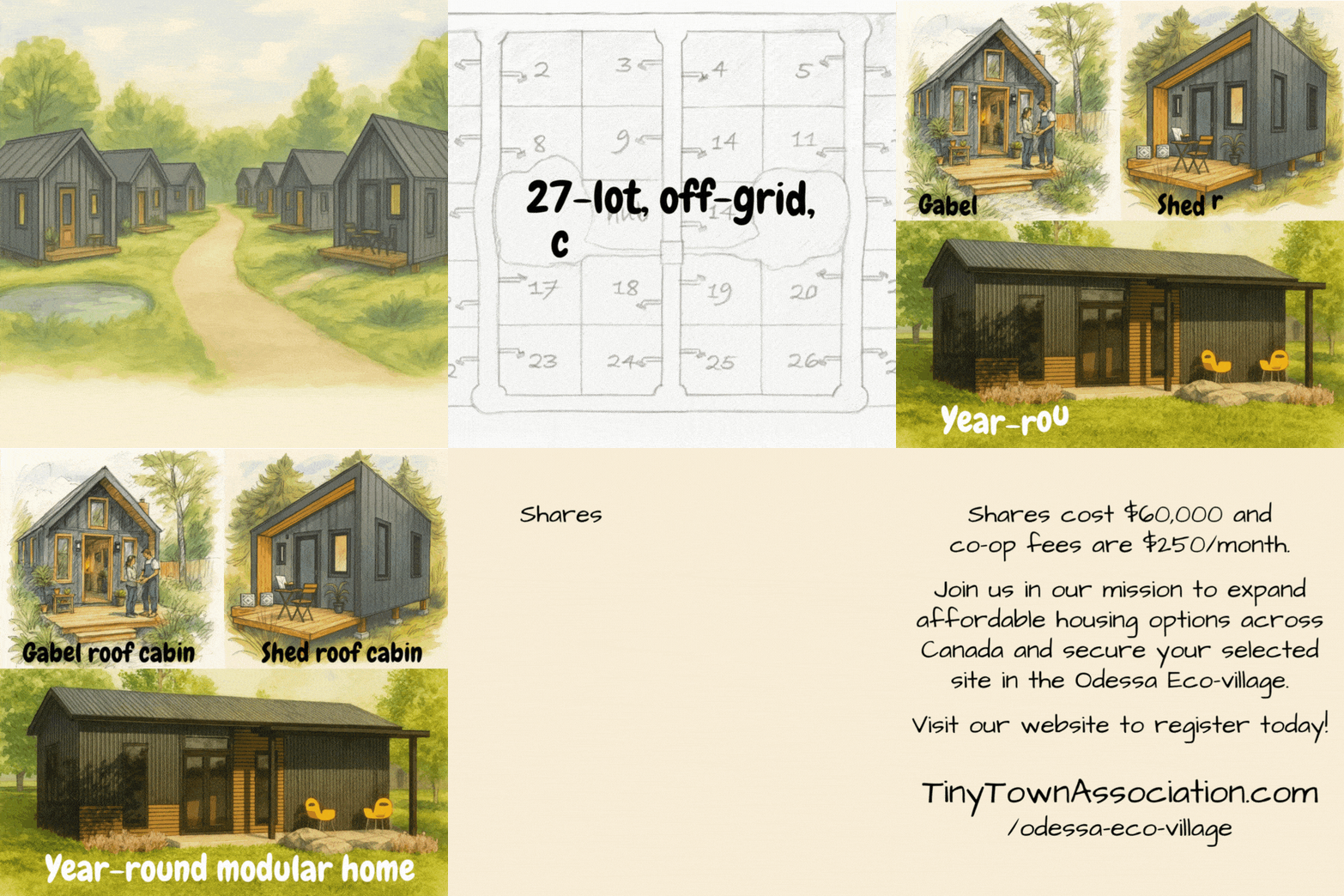
We have just uploaded our Agreement and Community Handbook for the Odessa Eco-village. Together they outline the obligations of the community and members, the cost to join the community, as well as how we plan to develop an affordable Eco-village. This is the culmination of an eight-year journey to find a way create community, where profit isn’t the reason for housing, and eco-living can be a lifestyle choice.
We are looking forward to breaking ground this Spring (2026), with the goal to have the village fully operational by the end of 2029.
If you wonder about your ability to afford a place to live either as someone starting out or an empty-nester that is looking to downsize; if you like the idea of community and knowing the people that live around you; if you think having your own space where you can garden and live autonomously is an unrealistic dream; if you are willing to trade a little time in the community for truly affordable living, then read about the Odessa Eco-village for more information. There are 27-spots in the community, and only 26 remain.
The Tiny Town Association is thrilled to unveil our newest project- an off-grid, cooperatively run, eco-village designed to redefine what affordable and sustainable communities can look like outside of urban boundaries. The Odessa Eco-village brings together innovation, sustainability, and community.
Nestled just outside of Kingston, Ontario, the Odessa Eco-village will feature a central community hub, 27 private lots, two ponds, landscaped green spaces, and connecting roads. Each lot includes:
A 10’x16’ cabin with your choice of a gable or shed style roof
A covered porch and deck
On-site parking
Roughly one acre of land
A high-efficiency composting toilet
A rooftop solar system
Inside the cabin, you’ll find an open main room with space for an off-grid bathroom. Members are welcome to personalize the cabins to make their own peaceful getaways. During the demonstration phase, members will only be able to visit the community for a maximum of 14 consecutive days, followed by a minimum 7-day absence. Rezoning will take time, but once acquired, the cabins can be year-round small modular homes.
At the heart of the site is the caretaker’s residence, which will evolve into a community hub where members can gather. Shares in the cooperative cost $60,000 with monthly co-op fees of $250. By joining, you’ll not only secure your spot in the first community, but you will also help expand affordable housing options across Canada. Ready to shape a more sustainable future? Register for the Odessa Eco-village here!
A BIG thank you to everyone that stopped by to say hi at the Tiny Home Show last Saturday and Sunday at the Ancaster Fairgrounds. Everyone’s positive enthusiasm was rejuvenating, and the interest in tiny home communities was reaffirming. I was glad that all age groups showed interest and a desire to live in our small modular home community. Based on the questions many people asked at the show, I will prepare a series of posts that provide insight.
The community focus has expanded over the years. Not only are people looking for affordable and attainable housing. but they are missing the community aspect in today’s world. We will continue to expand the “community” component of Tiny Town developments. We want to encourage you to share your thoughts on what that would look like to you, so we are holding a draw for a Tiny Town Association t-shirt. Images of the t-shirt can be seen in the photo of me in our Tiny Home Show booth. (One of the few times there wasn’t a lineup of people waiting to chat.)
Entry into the draw is simple. In your own words, tell us what would make living in our small modular developments a community. Is it the amenities, the social interaction (where/how that would happen), the community layout? Anything is possible. You may only submit one story which will enter you into the draw. The draw is random, we are not judging your thoughts, so every entry is an opportunity to win. The Tiny Town Association reserves the right to incorporate your ideas into our community model and will give kudos in return. We also may share all or part of your submission on the website, in print or use in presentations. If your story is under 250 words, we will award 1-entry and over 250 words we will award 2-entries. 1-additional entry will be awarded if you include a sketch or drawing to help illustrate your story, and 5-additional entries will be awarded if you send a link to a short video you create that explains and/or illustrates your thoughts. A small, medium, or large shirt will be mailed to the winner. Entries can be sent to
After the Ottawa TinyHome.Show, I felt it was important to share information on our projects. We have 2 in the works, and our private property project will be of interest to landowners that want to build a community. This video provides information on the projects, and we will continue to share the details of the projects as we go, providing a blueprint for others to follow.
Less Space More Life is a podcast exploring the future of tiny home living. Hosted by Chad and Matt from the Tiny Home Association (tinytownassociation.com) in Barrie, Ontario (Canada), this series spotlight on the opportunities and benefits of environmentally sustainable micro-housing, as well as the challenges to creating these new paths to affordable housing and home ownership.
Come on in. Make yourself at home! Less Space More Life is a podcast exploring the future of tiny home living. Hosted by Chad and Matt from the Tiny Home Association (tinytownassociation.com) in Barrie, Ontario (Canada), this series spotlight on the opportunities and benefits of environmentally sustainable micro-housing, as well as the challenges to creating these new paths to affordable housing and home ownership.
Our friends at Rentals.ca shared the latest data they have compiled on rental trends across Canada for January 2024, and its not encouraging.
February 2024 Press Release
Asking Rents Hit Another Record High in Canada, Rising 10% Annually in January 2024
Toronto, Canada – February 14, 2024 – Average asking rent for all property types increased by 10.0% annually to $2,196, reaching another record high in January 2024, according to Rentals.ca and Urbanation’s latest National Rent Report.
This increase reflects a 0.8% month-over-month rise, pushing the annual rate of rent growth to a four-month high. Compared to January 2020, before the onset of COVID-19 lockdowns, average asking rents have increased 20%, translating to a $373 per month increase.
“The Canadian rental market began 2024 where it left off in 2023, with rents surging to new highs,” said Shaun Hildebrand, President of Urbanation. “However, an underlying narrative has emerged between softening rents in expensive markets and strengthening rents in more affordable markets. These shifts in demand are symptomatic of a worsening supply situation for rentals in Canada.”
Among different property types, purpose-built rental apartments witnessed the most substantial growth, with average asking rents increasing by 13.5% over the past year to $2,107. Condominium rentals followed, experiencing a 4.1% annual increase to average rents of $2,372 in January. Meanwhile, house rentals saw a 5.6% year-over-year increase, reaching an average of $2,352.
One-bedroom apartment rents saw an increase of 12.6% annually, reaching a record average of $2,146. Similarly, two-bedroom apartments saw an 11.0% surge in asking rents to an average of $2,334, while three-bedroom rents averaged $2,638, marking an 11.6% increase from the previous year. Studio apartments also experienced strong growth, with rents rising by 11.8% annually to reach an average of $1,595.
Regional disparities in rent growth were evident, with Nova Scotia, Alberta, and Saskatchewan leading with annual rent inflation rates of 19.1%, 17.8%, and 17.5% respectively. British Columbia maintained its position as the most expensive province, with average asking rents reaching $2,529 for purpose-built and condominium apartments in January, albeit with a slower annual growth rate of 2.3%.
In Canada’s largest cities, Edmonton surpassed Calgary in rent inflation, posting a 17.1% annual increase to an average of $1,479 for purpose-built and condominium rentals. Vancouver remained Canada’s most expensive city, despite a 3.0% decrease in rents from the previous year, with an average asking rent of $3,055. Toronto saw a modest 2.4% increase in rents over the past year, reaching $2,830 on average.
Roommate rents across Canada hit a record high of over $1,000, with average asking rents for shared accommodations increasing by 18.5% annually to $1,010 in January. Vancouver and Toronto recorded the highest roommate rents at $1,338 and $1,311 respectively.
________________________________________
The National Rent Report charts and analyzes monthly, quarterly and annual rates and trends in the rental market on national, provincial, and municipal levels across all listings on the Rentals.ca Network for Canada. The data from the digital rental platform Rentfaster.ca is incorporated into this report.
Rentals.ca Network data is analyzed and the report is written by Urbanation, a Toronto-based real estate research firm providing in-depth market analysis and consulting services since 1981.
*The data includes single-detached homes, semi-detached homes, townhouses, condominium apartments, rental apartments and basement apartments (outlier listings are removed, as are single-room rentals.)
Are you interested in tiny home communities? Are you looking to live in a community, invest in a community, or support a community? Fill out our 3-question form and we’ll keep you updated on our progress in your area of interest. Together we can have an impact on affordable housing options in Canada. Sign up today! Tiny Town Communities – Get Involved
We’re gaining traction and interest from individuals, investors, business, and the media. With over 50 people having competed our “I’m Interested” form on https://communities.tinytownassociation.com we’re getting a good feel for the interest and housing needs of people in Ontario.
Recently our projects were highlighted in the Canadian Business Owner, Multicultural Entrepreneurs Business Community Magazine. I am very grateful for Rasheed’s continued support and assistance in spreading the word across the business community about our efforts to create affordable, sustainable, accessible, eco-friendly communities.